
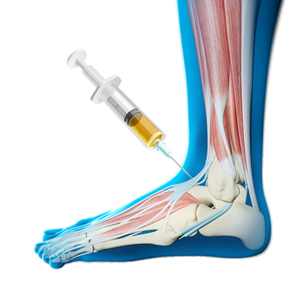
What are Platelet-Rich Plasma (PRP) Injections for the Ankle?
Platelet-Rich Plasma (PRP) injections in the ankle represent a regenerative, biologic therapy intended to alleviate pain, promote healing, and reduce inflammation in the ankle joint or associated soft tissues. The process involves drawing a sample of an individual’s blood, concentrating the platelets (which carry growth factors and signaling proteins), and injecting the PRP into the target area (e.g. joint space, tendons, ligaments) under imaging guidance.
What Are the Indications for PRP Injections in the Ankle?
PRP may be considered for a variety of ankle pathologies, including (but not limited to):
- Ankle osteoarthritis (mild to moderate)
- Chronic ankle instability or prior ligament injuries (e.g., anterior talofibular ligament, calcaneofibular ligament)
- Tendinopathies around the ankle (e.g. Achilles, posterior tibial, peroneal)
- Osteochondral lesions of the talus (OLT)
- Bursitis or soft tissue inflammation around the ankle
- Adjunctive therapy post-surgical repair to boost healing
What is the Procedure for PRP Injections in the Ankle?
The PRP ankle injection procedure is performed in a minimally invasive manner, typically with imaging guidance (ultrasound or fluoroscopy) to ensure precise placement. Key steps include:
- Blood draw: Usually 15–60 mL of the patient’s venous blood is collected.
- Centrifugation: The blood sample is spun in a centrifuge to separate components; platelets are concentrated into plasma, creating the PRP.
- Preparation of injection site: The ankle region is sterilized; a local anesthetic may be used to reduce discomfort.
- Injection: The prepared PRP is injected into the targeted location (intra-articular joint, tendon sheath, damaged ligament, lesion) under imaging guidance for accuracy.
- Duration: The entire process often takes about 15–30 minutes.
What Does Post-Injection Care for Ankle PRP Involve?
After receiving a PRP injection in the ankle, individuals should follow a structured recovery plan:
- Rest and protection: Minimal weight bearing for 24–48 hours.
- Medication: Avoid nonsteroidal anti-inflammatory drugs (NSAIDs) for ~1–2 weeks (or per physician’s protocol) so as not to blunt platelet activity.
- Activity restrictions: Avoid high-impact or strenuous loading for several weeks (timeline individualized).
- Monitoring and follow-up: Clinical assessments over 4–12 weeks to examine pain relief, functional improvement, and possible need for repeat injections.
?Individuals often report progressive symptom improvement within 4 to 8 weeks, though individual responses vary. Some cases may require 1–3 injections spaced several weeks apart depending on severity and clinical response.
What Are the Risks and Complications of Ankle PRP Injections?
PRP injections are generally considered safe, since they use autologous (patient’s own) blood; however, as with any invasive procedure, there are potential risks:
- Pain, swelling, or stiffness at the injection site
- Bruising or local bleeding / hematoma
- Infection (rare)
- Injury to adjacent structures (nerve, tendon, vessel)
- Flare reaction (temporary increase in symptoms)
- Variable clinical response: not all patients achieve full relief
Who Is a Good Candidate, and Who Should Avoid It?
Good candidates may include individuals with moderate degenerative changes, persistent tendon pain not responsive to conservative therapy, or ligament injuries failing standard treatment.
Relative contraindications include:
- Severe, advanced osteoarthritis with major joint destruction
- Active infection or skin lesions over the injection site
- Coagulopathy or platelet disorders
- Use of anticoagulants or bleeding risk
- Systemic conditions (e.g., malignancy, severe uncontrolled diabetes)
If you wish to be advised on the most appropriate treatment, please call to schedule an appointment or click to request an appointment online.